
The Security of the Believer: A Topical Study, Worked
Can a believer's salvation be lost? This page doesn't answer that for you. It shows you how to answer it yourself, by working one complete topical study, step by step, on a question Christians have argued over for centuries.

Can a believer's salvation be lost? This page doesn't answer that for you. It shows you how to answer it yourself, by working one complete topical study, step by step, on a question Christians have argued over for centuries.
The topical method follows one subject through many passages. Each writer of Scripture touches a subject from his own angle, and no single passage says everything. Two rules guide the whole study:
- Scripture interprets Scripture. Cross-reference the thought, not just the word.
- A doctrine is biblical only if it accounts for everything Scripture says on it. Collect the passages that unsettle you along with the ones that comfort you.
Each step carries a tag: O for observation, I for interpretation, C for correlation, A for application. A ? marks a problem, something specific you don't yet understand.
Scripture quotations are from the Berean Standard Bible (BSB).
Before you begin: prepare
You don't need to have read Henrichsen's book to follow this study. Every step is explained where it comes. What you do need is a prepared heart and a little preparation of your materials. Tick these off before Step 1.
- [ ] Pray first
Ask God to open your understanding before you open the text. Full understanding of Scripture needs saving faith and the Holy Spirit; study is not a technique that works without Him. "Open my eyes that I may see wondrous things from Your law." (Psalm 119:18, BSB) If something confuses you, ask: "Now if any of you lacks wisdom, he should ask God, who gives generously to all without finding fault, and it will be given to him." (James 1:5, BSB)
- [ ] Meditate on a passage before you analyze anything
Biblical meditation is not emptying your mind. It is filling it with God's Word and turning that Word over slowly. "But his delight is in the Law of the LORD, and on His law he meditates day and night." (Psalm 1:2, BSB) Choose one passage from this study, such as John 10:27–29. Read it aloud three times, slowly. Ask what it says about God and what it asks of you. Hold a phrase in mind through the day.
- [ ] Come willing to be corrected
This topic divides faithful Christians. Write down what you believe now, then set it aside. Let every passage speak, including the ones that unsettle you. Be willing to accept what God shows you before you decide what it is.
- [ ] Set aside unhurried time
A topical study is not done in one sitting. Plan several sessions (see How long it takes, below), and stop at the end of a step rather than in the middle of one.
- [ ] Choose one translation and stay with it
Use a word-for-word translation for study. This page uses the Berean Standard Bible (BSB). Compare others later, not while you are gathering.
- [ ] Gather your tools
Your Bible, a concordance, and a topical index or topical Bible for finding references. Paper and a pen, or a worksheet, for your Observations sheet.
- [ ] Read every reference in its context
Before you write about a verse, read the paragraph around it, and ideally the whole chapter. A verse lifted out of its context can be made to say almost anything.
- [ ] Ask someone to study alongside you
Optional, but valuable. A friend or a small group can check your observations, ask questions you missed, and encourage you in the application. They encourage; they don't police.
How long it takes
About 5½ to 8½ hours for this study as worked here, with 16 references, spread over four to six sessions. The basic steps (1–7) alone take about 4 to 5½ hours. These times are estimates, not measured. A first topical study runs longer; later ones run shorter.
Step | What you do | Time |
|---|---|---|
Preparation | Prayer and meditation | 20–30 min |
1 (C) | Choose the topic and find the references | 30–45 min |
2 (O) | Observations sheet (it stays open throughout) | 60–90 min |
3 (I) | Key thought for each of 16 references, read in context | 45–60 min |
4 (C) | Arrange into categories | 20–30 min |
5 (C) | Outline | 20–30 min |
6 (I) | Key thoughts for each division and the whole | 15–20 min |
7 (A) | Choose and plan one application | 20–30 min |
8 (I) | Elaboration (advanced) | 30–45 min |
9 (C) | Chart (advanced) | 15–30 min |
10 (I) | Outside material (advanced) | 60–90 min |
Close | Closing prayer | 5–10 min |
Total | About 5½–8½ hours |
A workable plan in five sittings: preparation with Steps 1–2; Step 3; Steps 4–7; Steps 8–9; Step 10 and the closing prayer. Application doesn't end with the last sitting.
A prayer for this study
Pray it as it is, or let it start your own prayer.
Father, Your Word is truth, and I come to it needing You to open my eyes. I come with a question Your people have wrestled with for centuries, and I bring my own opinions with me. Help me set them down.
Let me hear every passage You have given, the ones that comfort me and the ones that warn me. Keep me from bending one to silence the other.
Holy Spirit, guide me into the truth, and guard me from pride in whatever I find. Lord Jesus, You are the Good Shepherd: let me know Your voice and follow You.
Whatever this study shows me, make me more faithful, more humble, and more grateful for Your grace. In Jesus' name, amen.
Step 1 (C): Choose the topic, its boundaries and its references
Topic: the security of the believer.
Related words to search under: keep, guard, shield, seal, never perish, snatch, separate, remain, continue, hold firmly, fall away, turn away, stumble.
Boundaries: the New Testament. This is a large topic, and the bigger the topic, the narrower the boundaries need to be. The Old Testament has much to say about God's faithfulness to His people, but the question as Christians argue it is asked of the New Testament.
Purpose: to gather what the New Testament says about whether a believer's salvation is secure, and to account for every passage, the warnings as well as the promises.
References. These 16 were gathered with a topical index and a concordance under the related words above. There are more. Sixteen is enough to show the method, and you can add your own as you go.
# | Reference |
|---|---|
1 | |
2 | |
3 | |
4 | |
5 | |
6 | |
7 | Jude 24 |
8 | |
9 | |
10 | |
11 | |
12 | |
13 | |
14 | |
15 | |
16 |
Step 2 (O): Start the Observations sheet
The Observations sheet stays open for the whole study, and you add to it in any order. Record every detail you notice: who acts, what is said, when, why, and how. Note the key nouns and verbs. Write a problem down exactly. "Hebrews 6 is confusing" is not a problem; "who are the people described in Hebrews 6:4–5?" is.
A sample of this study's sheet:
Tag | Reference | Entry |
|---|---|---|
O | Jesus is the one who gives eternal life. The promise is "they will never perish." | |
O | "No one can snatch them" is said twice: once of Jesus's hand, once of the Father's. | |
? | Does "no one" include the sheep themselves, or only someone acting on them from outside? | |
O | The list ends with "anything else in all creation." Paul says he is "convinced." | |
O | Two things are named: "through faith" and "by God’s power." Believers are "shielded." | |
C | The words "through faith" set beside "if indeed you continue in your faith." | |
O | The order of the tenses: "We have come to share" (already) "if we hold firmly to the end" (still to come). | |
O | Five things are said of these people before "and then have fallen away": enlightened, tasted the heavenly gift, shared in the Holy Spirit, tasted the goodness of the word, tasted the powers of the coming age. | |
? | Do those five describe someone born again, or someone who came near to faith without being born again? | |
O | "If anyone does not remain in Me." The condition is stated, then its outcome. | |
O | They "escaped the corruption of the world through the knowledge of our Lord and Savior Jesus Christ." | |
? | Is "the knowledge of our Lord" here saving knowledge? | |
O | "I never knew you," not "I no longer know you." | |
C | Matthew 7:23 with 1 John 2:19 | Both explain an apparent believer's failure as never having belonged. |
O | Human striving ("strive") and God's choosing ("election") appear in one sentence. | |
A | (yours) | A possible application is marked A as it occurs to you. Yours belong to you, so none are written here. |
Step 3 (I): Write the key thought of each reference
Beside each reference, write its main idea in your own words, in one sentence. Expect to add to the Observations sheet as you go.
# | Reference | Text (BSB) | Key thought |
|---|---|---|---|
1 | [37] Everyone the Father gives Me will come to Me, and the one who comes to Me I will never drive away. [38] For I have come down from heaven, not to do My own will, but to do the will of Him who sent Me. [39] And this is the will of Him who sent Me, that I shall lose none of those He has given Me, but raise them up at the last day. | The Father's will is that Jesus lose none of those the Father has given Him. | |
2 | [27] My sheep listen to My voice; I know them, and they follow Me. [28] I give them eternal life, and they will never perish. No one can snatch them out of My hand. [29] My Father who has given them to Me is greater than all. No one can snatch them out of My Father’s hand. | Jesus's sheep will never perish, and no one can snatch them from His hand or the Father's. | |
3 | [38] For I am convinced that neither death nor life, neither angels nor principalities, neither the present nor the future, nor any powers, [39] neither height nor depth, nor anything else in all creation, will be able to separate us from the love of God that is in Christ Jesus our Lord. | Nothing in all creation can separate believers from God's love in Christ. | |
4 | [13] And in Him, having heard and believed the word of truth—the gospel of your salvation—you were sealed with the promised Holy Spirit, [14] who is the pledge of our inheritance until the redemption of those who are God’s possession, to the praise of His glory. | Believers are sealed with the Holy Spirit, the pledge of their inheritance. | |
5 | [6] being confident of this, that He who began a good work in you will carry it on to completion until the day of Christ Jesus. | God will carry to completion the good work He began. | |
6 | [3] Blessed be the God and Father of our Lord Jesus Christ! By His great mercy He has given us new birth into a living hope through the resurrection of Jesus Christ from the dead, [4] and into an inheritance that is imperishable, undefiled, and unfading, reserved in heaven for you, [5] who through faith are shielded by God’s power for the salvation that is ready to be revealed in the last time. | Believers are shielded by God's power, through faith, for an inheritance kept in heaven. | |
7 | Jude 24 | [24] Now to Him who is able to keep you from stumbling and to present you unblemished in His glorious presence, with great joy— | God is able to keep believers from stumbling and present them unblemished. |
8 | [5] I am the vine and you are the branches. The one who remains in Me, and I in him, will bear much fruit. For apart from Me you can do nothing. [6] If anyone does not remain in Me, he is like a branch that is thrown away and withers. Such branches are gathered up, thrown into the fire, and burned. | The branch that does not remain in Christ is thrown away and burned. | |
9 | [22] But now He has reconciled you by Christ’s physical body through death to present you holy, unblemished, and blameless in His presence— [23] if indeed you continue in your faith, established and firm, not moved from the hope of the gospel you heard, which has been proclaimed to every creature under heaven, and of which I, Paul, have become a servant. | Christ will present you blameless, if you continue in your faith. | |
10 | [14] We have come to share in Christ if we hold firmly to the end the assurance we had at first. | Sharing in Christ is tied to holding our first assurance firmly to the end. | |
11 | [4] It is impossible for those who have once been enlightened, who have tasted the heavenly gift, who have shared in the Holy Spirit, [5] who have tasted the goodness of the word of God and the powers of the coming age— [6] and then have fallen away—to be restored to repentance, because they themselves are crucifying the Son of God all over again and subjecting Him to open shame. | Those who were enlightened and then fell away cannot be restored to repentance. | |
12 | [26] If we deliberately go on sinning after we have received the knowledge of the truth, no further sacrifice for sins remains, [27] but only a fearful expectation of judgment and of raging fire that will consume all adversaries. | Deliberately going on in sin after knowing the truth leaves only judgment. | |
13 | [20] If indeed they have escaped the corruption of the world through the knowledge of our Lord and Savior Jesus Christ, only to be entangled and overcome by it again, their final condition is worse than it was at first. [21] It would have been better for them not to have known the way of righteousness than to have known it and then to turn away from the holy commandment passed on to them. | Those who escaped through knowing Christ and were overcome again end worse than before. | |
14 | [21] Not everyone who says to Me, ‘Lord, Lord,’ will enter the kingdom of heaven, but only he who does the will of My Father in heaven. [22] Many will say to Me on that day, ‘Lord, Lord, did we not prophesy in Your name, and in Your name drive out demons and perform many miracles?’ [23] Then I will tell them plainly, ‘I never knew you; depart from Me, you workers of lawlessness!’ | Many who called Jesus Lord and worked in His name were never known by Him. | |
15 | [19] They went out from us, but they did not belong to us. For if they had belonged to us, they would have remained with us. But their departure made it clear that none of them belonged to us. | Those who left showed they never belonged; those who belonged would have remained. | |
16 | [10] Therefore, brothers, strive to make your calling and election sure. For if you practice these things you will never stumble, | Diligence in confirming God's call and choice guards against stumbling. |
Step 4 (C): Arrange the references into categories
Read down your key thoughts and ask what main categories they suggest, and how you would outline this subject for someone else. A reference can go in more than one category. Four categories came out of this study's key thoughts:
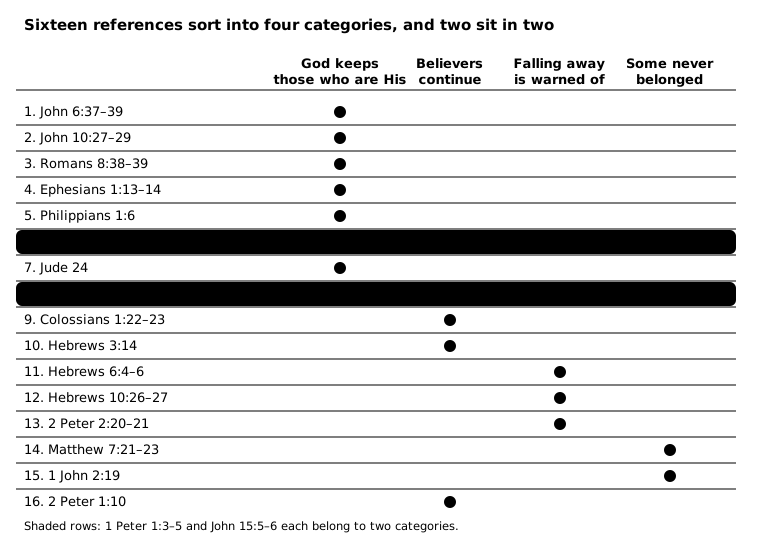
The grid already shows what the rest of the study has to account for: the passages don't sort into two camps that ignore each other. 1 Peter 1:3–5 says God keeps believers and that He keeps them through faith. John 15:5–6 calls believers to remain and warns what happens to a branch that does not.
Step 5 (C): Outline the categories
Turn the categories into an outline: the major divisions, the subpoints under each, and the key verses beside every line. Keep it simple. The simpler the outline, the better you have understood the material. Keep the purpose from Step 1 in view.
Purpose: to account for every passage, the warnings as well as the promises.
- God keeps those who are His
- The Father's will and the Son's hand — John 6:37–39; John 10:27–29
- Nothing in creation can separate — Romans 8:38–39
- Sealed, shielded, carried to completion — Ephesians 1:13–14; Philippians 1:6; 1 Peter 1:3–5; Jude 24
- Believers continue in Christ
- Remaining and continuing — John 15:5–6; Colossians 1:22–23
- Holding firm to the end — Hebrews 3:14; 2 Peter 1:10
- Kept through faith — 1 Peter 1:5
- Scripture warns against falling away
- Falling away after receiving much — Hebrews 6:4–6
- Deliberate sin after knowing the truth — Hebrews 10:26–27
- Overcome again after escaping — 2 Peter 2:20–21
- Cut off for not remaining — John 15:5–6
- Some who seemed to belong never did
- "I never knew you" — Matthew 7:21–23
- "they did not belong to us" — 1 John 2:19
Two references sit in two divisions, as they did in the categories: 1 Peter 1:3–5 under I and II, and John 15:5–6 under II and III. A reference may sit in more than one division.
Step 6 (I): Write the key thought of each division, then of the whole study
Write one sentence for each major division of the outline, then one sentence for the whole study: its big idea. The study narrows like a funnel, from sixteen verse-level thoughts to four, then to one.
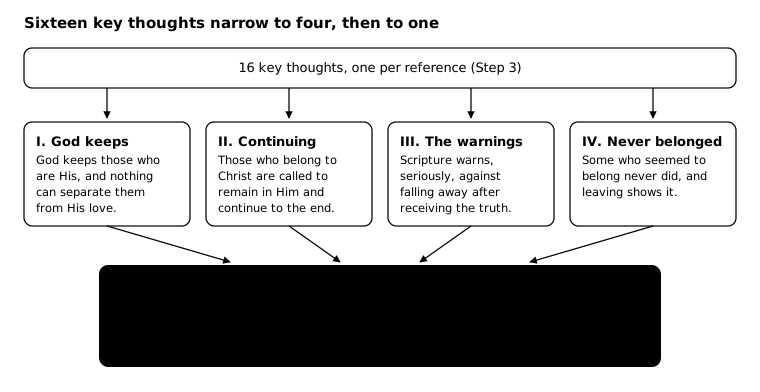
The whole-study key thought describes what all four divisions say together. It does not choose between them. Deciding how they fit is interpretation, and that waits for Step 10.
Step 7 (A): Choose one application
This step is yours, and it is left blank on purpose. A study whose application someone else wrote for you is not your study. Go back to the A entries on your Observations sheet, choose one, and work it through in four parts:
Part | Yours |
|---|---|
The problem: where your life or thinking runs against what you found | |
A specific example: one real instance, with a time and a place | |
The solution: what the passages show instead | |
Specific actions: what you will do, numbered |
Application is a lifelong process, not a single event. Come back to it.
Step 8 (I): Elaborate on the key thought
Write a few paragraphs developing the whole-study key thought from Step 6. It is the pivot: open with it, stay close to it, and come back to it.
The New Testament rests the believer's security on God's keeping power, and the same writers call believers to continue in the faith and warn them seriously against falling away. A faithful account holds both together.
The promises are not vague. Jesus says His sheep "will never perish," and He says twice that no one can snatch them from His hand and the Father's. Paul names everything he can think of, from death to "anything else in all creation," and says none of it can separate believers from God's love. The one keeping them is God, and the writers say so with confidence.
The warnings are just as plain. Hebrews describes people who were enlightened and shared in the Holy Spirit, and then fell away. Jesus says a branch that does not remain in Him is thrown into the fire. Paul ties being presented blameless to "if indeed you continue in your faith." These are written to churches, to people the writers count as believers, and they are written as real dangers.
One verse sets both lines side by side. Peter says believers are "shielded by God’s power" and that they are shielded "through faith." God keeps, and He keeps through faith that continues. How those two fit together is where Christians divide, and the outline can't settle it. Two problems on the Observations sheet are still open: who the people in Hebrews 6 are, and what "knowledge" means in 2 Peter 2. Those questions go to Step 10.
The study ends where it began: security rests on God's keeping, believers are called to continue, the warnings are serious, and a faithful account holds both together.
Step 9 (C): Chart the study
A chart lets you see the whole study at once and how its parts relate. The kind of topic decides the kind of chart. This study sets three things side by side, so it uses three columns:
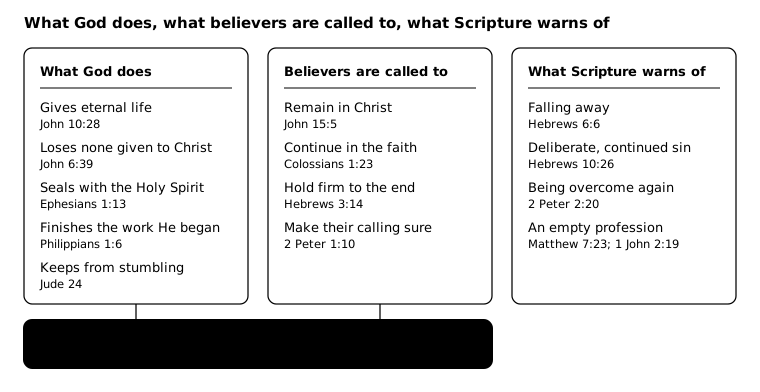
Read across the chart, not down one column. Each column is true to its passages, and the study is only complete when all three are held at once.
Step 10 (I): Check your work against outside material
Only now, after your own study, read what others have concluded. Outside material checks your conclusions; it doesn't replace them. Add to your study or change it wherever you find you missed something.
Faithful Christians read these same passages in four main ways. Each affirms both lines of the study. They differ on how the lines fit together, and each has texts it finds harder than the others.
View | Held by, among others | The promises | The warnings | Texts it works hardest to explain |
|---|---|---|---|---|
Perseverance of the saints | Reformed churches (Westminster Confession, chapter 17); many Baptists (Baptist Faith & Message 2000, article V) | Everyone truly born again is kept by God and will persevere to the end | Real means God uses to keep His people; one who falls away was never born again (1 John 2:19) | Hebrews 6:4–5, describing those who fall away |
Eternal security (Free Grace) | Zane Hodges and the Free Grace movement | Eternal life is secured the moment one believes, whatever follows | They concern discipline, fellowship or reward, not salvation itself | |
Conditional security | Wesleyan-Arminian churches; Reformed Arminians, such as Free Will Baptists | No outside power can take a believer from God | A true believer can fall away by turning from faith; Reformed Arminians hold such a fall cannot be undone (Hebrews 6:4–6) | |
Middle knowledge (Molinist) | William Lane Craig, "Lest Anyone Should Fall" (1991) | God knows how each person would freely respond in every circumstance and gives grace He knows will keep them | Real means: a believer could fall away, and in fact does not, partly because of the warnings | Critics ask whether a fall that never happens makes the warnings real, and what makes those "would" truths true |
The fifth article of the Remonstrance of 1610, the founding statement of the Arminian party, left this question open for further study of Scripture. The disagreement is that old.
If your conclusion departs from the historic readings, give it further study before you hold it. Then record where you stand:
Yours | |
|---|---|
My conviction | |
The texts that settle it for me | |
The texts I still find hardest |
Close in prayer
End where you began. Pray it as it is, or let it start your own prayer.
Father, thank You for Your Word, and for every passage in this study, the promises and the warnings alike. Thank You that my hope rests on Your faithfulness and not on my own strength.
Where I have understood, help me hold it humbly. Where questions remain, give me patience to keep studying and grace toward those who see them differently.
Lord Jesus, keep me close to You. Let me hear Your voice and follow You, today and to the end.
Holy Spirit, take what I have learned out of these pages and into my life. Show me the one thing You would have me do, and give me the strength to do it. In Jesus' name, amen.
Study it yourself
This page worked one topic so you could watch the method. The method is Walter Henrichsen's topical study, set out here in Scrollwork's own words. Scrollwork Table, a study companion coming in 2027, will walk you through it with any topic you choose.
Sources
- Scripture: the Berean Standard Bible (BSB), public domain, quoted character for character from Scrollwork's text.
- Method: Walter A. Henrichsen and Gayle Jackson, Studying, Interpreting, and Applying the Bible (Zondervan), the topical method, paraphrased. The example on this page is original.
- Westminster Confession of Faith, chapter 17, "Of the Perseverance of the Saints."
- The Baptist Faith & Message 2000, article V.
- William Lane Craig, "Lest Anyone Should Fall": A Middle Knowledge Perspective on Perseverance and Apostolic Warnings, International Journal for Philosophy of Religion 29 (1991): 65–74.
- The Remonstrance (1610), article 5.
---
The Security of the Believer: A Topical Study, Worked · v1.3.0 · Scrollwork


Discussion
1 Comment